
Your Network, Physically.
Live. In 3D and 2D.
Every platform can draw a graph of what talks to what. WireTrace answers the question that graph cannot: where does everything physically live, how is it actually wired, and what changed since yesterday? The digital twin is a living model of your buildings, floors, racked switches and discovered cabling - reconciled against reality on every run.
The 3D Twin: a navigable model of your estate
Buildings sit on zone pads around a central boundary island: the Internet edge, firewalls, core switches and the VPN entry point. Racked switches render inside their floors with their device clusters, and discovered trunks route as bundled highways into the core. Switch tiers (core, aggregation, access) are inferred from real trunk counts, and color modes overlay Domain (IT/OT/IoT/IoMT), Risk, or Purdue level with segmentation-violation flags. Nothing is invented: every object is an asset record, and every boundary node appears only when its underlying signal exists in traffic, configuration, or parsed VPN sessions.
The 2D Diagram: the daily tool for engineers and auditors
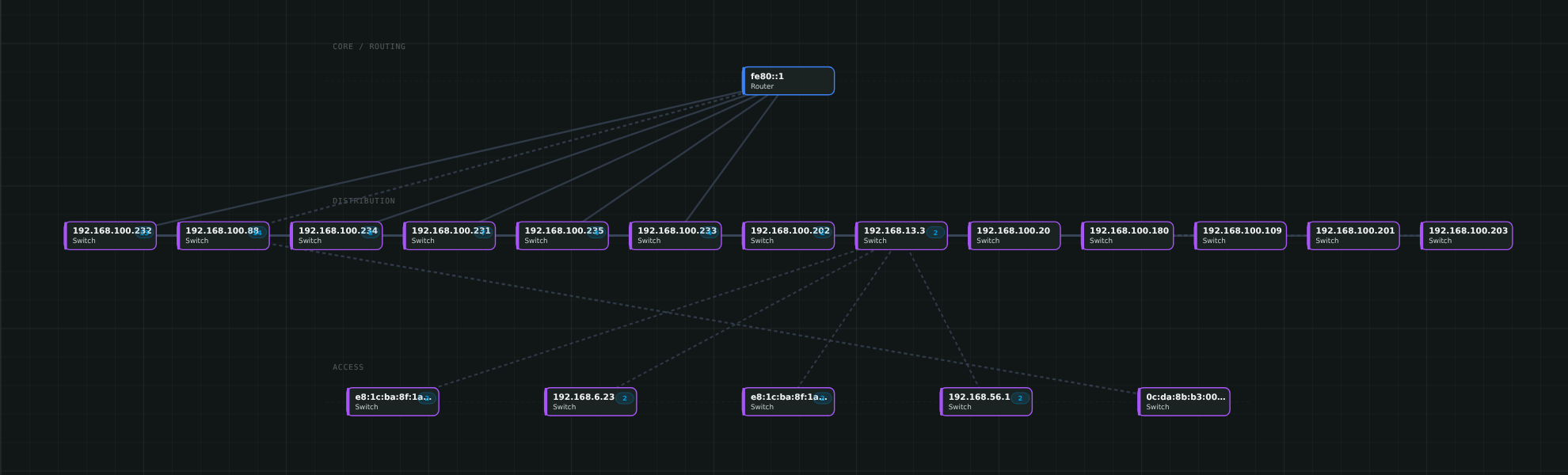
The same model, flattened into a tiered diagram that works before a single building is defined. Core, distribution and access lanes are laid out automatically; solid edges are confirmed by two or more independent sources, dashed edges are single-source discoveries, and a coverage badge states plainly how much of the estate the evidence actually covers. Pick any two assets and Trace Path reconstructs the route between them: layer-2 hops from bridge tables and discovered links, routed layer-3 hops resolved by longest-prefix match across collected routing tables - each hop with its evidence source and confidence. Where visibility ends, the twin says so instead of guessing. One click exports the diagram as an audit-grade PDF, the artifact an IEC 62443 zone-and-conduit review asks for.

Why "digital twin" and not "network diagram"
A drawing shows what you believe. Discovery shows what exists. A twin earns the name by holding both at once and surfacing the difference - so a disagreement is a finding, not a rendering error.
Recorded intent
The placement and cabling your organisation believes it has: buildings, floors, subnet-to-location mappings, and links an engineer has confirmed as ground truth.
Observed reality
What discovery actually finds: assets identified passively from live traffic, and cabling walked over LLDP and CDP via SNMP from each placed switch.
The drift between them
Every discovery run reconciles the model instead of redrawing it. Links added, removed, or moved to a different port land in a change log with provenance.
Confirmed ground truth
One click marks a link as confirmed. Confirmed links are never auto-pruned, and if one ever disappears from discovery the twin flags it louder than ordinary drift.
What teams do with it
Respond at the Right Cabinet
An alert names an asset; the twin names the building, floor, switch and port. Mean time from alert to hands-on drops when nobody is chasing a spreadsheet.
Physical Blast Radius
See what shares a compromised device's switch and rack - not just what it talks to - before deciding whether isolating it is safe.
Verify Segmentation Visually
Zone boundaries drawn over physical placement make a violation visible instead of inferable from a table of rules.
Prove the Control Is in the Path
Trace the real L2/L3 path between two assets, hop by hop with evidence and confidence, to show a firewall is genuinely in line - not merely configured.
Catch Unauthorized Change
A cable moved to a different port, a vanished switch, a new uplink: every discovery run reconciles the model and logs the drift, with before and after.
Audit Evidence on Demand
Export the tiered 2D diagram as an audit-grade PDF with coverage and confidence inline - the artifact an IEC 62443 zone-and-conduit review asks for.
Built in four moves
The whole setup is two inputs and two clicks. Assets are already there - discovered passively from live traffic before you touch anything. From then on the twin reconciles itself on every discovery run; the tiers, risk overlay and drift log are automatic.
Define buildings & floors
Name your sites once: buildings and the floors inside them. Minutes of typing, done one time.
Map subnets to locations
Point each CIDR at the floor it lives on. This is the key that tells the twin where every switch belongs.
Auto-place
One click drops every discovered switch and router into the right room by longest-prefix subnet match, and cleans up placements whose asset no longer exists.
Discover the cabling
One click polls each placed switch over SNMP, walks LLDP then CDP, and draws the real wires: trunks between switches and links down to devices.
Honest by design. Which room a switch sits in is a fact about the building, not the network, so it enters the model through one-time operator input and is ranked above machine inference. Asset capture is passive; cable discovery polls switches over SNMP from the management interface only, and is operator-initiated. Works across IT, OT, IoT and IoMT estates, fully on-premise, including air-gapped sites.
See your own network in the twin.
A demo takes thirty minutes. Your buildings, your switches, your cabling - not a canned dataset.